
Despite trailing the benchmark Nifty 50, small and midcap (SMID) stocks appear pricey on a 12-month forward price-to-earnings (P/E) basis. The Nifty trades at roughly 21x forward earnings, compared with around 28x for both the Nifty Smallcap 100 and Nifty Midcap 100 indices.

Market experts say India's IPO ecosystem has matured to support both primary and secondary issuance, rendering the mix less consequential.

Just over a year ago, India was investors' top pick among EMs. Its slide down the rankings follows $30 billion (over 2.5 trillion) of foreign selling over the past 12-13 months.

Shares of Billionbrains Garage Ventures, the parent of online broking platform Groww, soared nearly 30 per cent on their market debut on Wednesday, defying the recent trend of muted listings. The stock opened at Rs 112 and hit a high of Rs 134.4 before settling at Rs 128.85 on the NSE - a gain of 28.85 per cent over its issue price of Rs 100.

The average daily turnover (ADTV) in the derivatives market rose to a 12-month high in October, touching 506 trillion - up nearly 46 per cent since June - as volatility picked up and concerns over further regulatory tightening eased. Derivatives activity had slumped earlier this year after the Securities and Exchange Board of India (Sebi) capped weekly expiries to two days and discontinued weekly contracts on non-benchmark indices.

The rise of algorithmic and high-frequency trading brings efficiency but also demands robust risk controls, real-time monitoring and compliance safeguards, Securities and Exchange Board of India Chairman Tuhin Kanta Pandey told the Morningstar Investment Conference India 2025.

'...aggressive pricing amid volatility, but these are exceptions.'

With several $500 million-plus deals in the pipeline -- including ICICI Prudential AMC, Lenskart, PhonePe, Groww, PhysicsWallah, Meesho, Pine Labs, and Zepto -- investment bankers look poised for another year of hefty bonuses in 2025.

LG Electronics India made a dazzling market debut on Tuesday, ending 48 per cent higher than its issue price and surpassing its South Korean parent in market value.

This marks the strongest DRHP filing tally since 1996, when 428 firms sought to enter India's equity markets.

'Periods of vacancy, which have become more common in recent years, can affect the pace of decision-making.'

For LG Electronics India, the Rs 11,607 crore initial public offering (IPO) is not just a fundraising exercise. The company's senior executives describe it as a step towards becoming "future-ready", showcasing financial strength while preparing for the next phase of growth in a market they see as still underpenetrated.

The new UPI IDs will follow formats such as abc.bkr@validhdfc or xyz.mf@validhdfc. For easier recognition, they will also carry a white 'thumbs up' icon inside a green triangle.
Tata Capital is set to launch India's largest ever initial public offering (IPO) by a non-banking financial company (NBFC), valuing the Tata group firm at Rs 1.38 trillion. This will make the company India's fifth-most-valued NBFC after Bajaj Finance (Rs 6.12 trillion), Bajaj Finserv (Rs 3.2 trillion), Jio Financial Services (Rs 1.87 trillion), and IRFC (Rs 1.59 trillion).

'If we want to pivot meaningfully from a services-driven economy to a technology and manufacturing-led one.'

The Securities and Exchange Board of India (Sebi) has planned a slew of further relaxations to facilitate easier registrations of foreign portfolio investors (FPIs), including a common know-your-client (KYC) and smoother documentation through India digital signature.
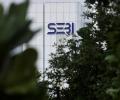
The Securities and Exchange Board of India (Sebi) will let Category-I and-II alternative investment funds (AIFs) run a dedicated "co-investment" (CIV) scheme for accredited investors, doing away with an earlier requirement of a separate portfolio-manager licence. The rules notified on Monday are aimed at reducing compliance burden for the AIF managers.
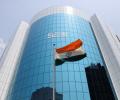
'The investigation is at a very critical stage. We are not going to give every single document.'

'The hearing is not adversarial but inquisitorial in nature -- it allows Sebi to examine the context, the strategy, and the intent behind the trades, particularly when algorithmic and expiry-day trading are involved.'

'Market momentum and investor interest are at unprecedented levels, making this the opportune moment.'
 © 2026 Rediff.com - Investor Information - Advertise with us - Disclaimer - Privacy Policy - Sitemap - Feedback - About us - Terms of use - Grievances